
Signs Your Tacoma Chimney Flashing Needs Repair (and What It Costs)
With 39 inches of rain a year, failing chimney flashing can wreck your Tacoma home's ceilings and masonry. Here is how to spot damage and what repairs cost.
Why Chimney Flashing Fails in Western Washington
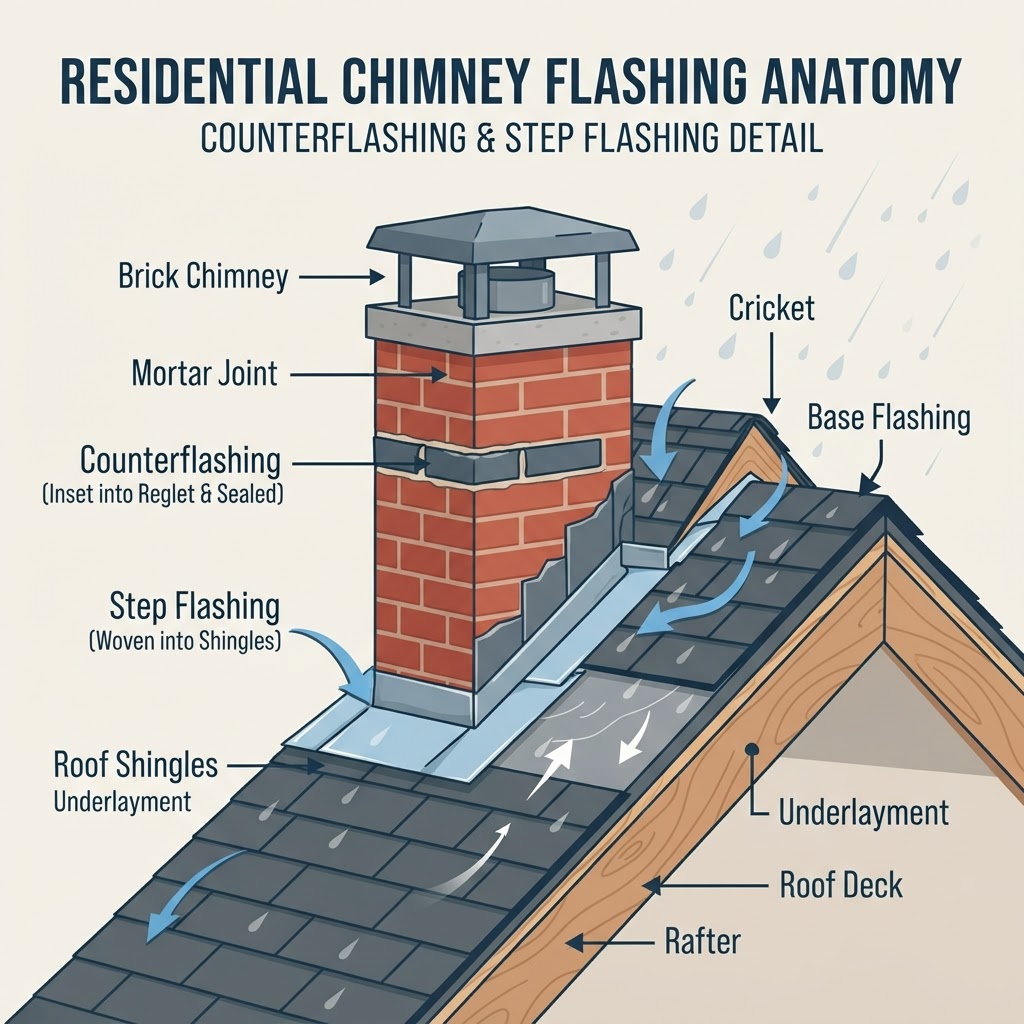
Chimney flashing serves as the watertight transition between your home's roofing material and the masonry of the chimney stack. In Western Washington, where Tacoma averages around 39 inches of rainfall annually, this seam undergoes continuous hydrostatic pressure. The flashing system typically consists of two layers: base flashing extending beneath shingles and up the stack, and counterflashing embedded into mortar joints with a reglet cut.
Over time, the differing expansion and contraction rates of brick, wood framing, and sheet metal stress these junctions. Combined with marine winds off Puget Sound and winter freeze-thaw shifts, standard roof sealants dry out, metal corrodes, and mortar joints loosen, allowing driving rain to bypass the barrier.
Critical Warning Signs of Leaking Flashing
Detecting flashing issues early prevents secondary structural issues like dry rot, saturated insulation, and rusted fireplace components. While some leaks show up immediately during a heavy South Sound downpour, others deteriorate building materials silently behind drywall.
Homeowners in historic neighborhoods such as the Stadium District, North End, and Hilltop frequently encounter flashing failures where aging masonry interfaces with updated composite or cedar shake roofs.
- Discolored drywall, brown water rings, or peeling paint on ceilings near the chimney chase
- Damp smells, visible mold, or wet insulation inside the attic surrounding the flue
- Rusted fireplace dampers, rusted firebox grates, or damp firebricks after a wind-driven rain
- Lifted, warped, or rusted step flashing along the roofline visible from ground level
- Cracked, crumbling mortar along the horizontal reglet line where counterflashing enters the brick
Tacoma-Area Costs for Chimney Flashing Repair
The cost of flashing repair depends on roof pitch, accessibility, whether the existing metal can be resealed, or if complete custom sheet metal fabrication is required. Masonry counterflashing cut directly into mortar requires careful masonry work to maintain watertight performance under Washington State residential building codes.
Minor Resealing & Caulk Maintenance ($200 - $450)
Best for intact metal where polyurethane sealant has separated or dried. Involves scraping failed sealants, cleaning metal, and applying high-grade elastomeric sealant.
Step & Base Flashing Replacement ($450 - $900)
Necessary when sheet metal is rusted or torn. Involves lifting surrounding shingles, replacing step flashing cards, and integrating weather-resistant underlayment.
Full Custom Counterflashing & Reglet ($800 - $1,600+)
Cutting a new horizontal reglet groove into brick mortar, custom-bending corrosion-resistant aluminum or copper, embedding counterflashing, and tuckpointing the joint.
Flashing Repair with Cricket Installation ($1,200 - $2,500+)
Recommended for chimneys wider than 30 inches to divert heavy rainwater pooling on the upslope roof edge, common on West End and Fircrest homes.
Industry Standards: NFPA 211 and Water Intrusion
The National Fire Protection Association standard NFPA 211 mandates that chimneys and vents maintain structural soundness and proper clearance from combustible materials. When water penetrates through failed flashing, it compromises nearby wooden framing members and accelerates deterioration of the interior clay flue or chimney liner.
According to Chimney Safety Institute of America (CSIA) standards, external water penetration is among the most destructive forces facing residential chimneys. In Pierce County, allowing water to linger inside unlined or older masonry chimneys causes rapid mortar spalling during mid-winter cold snaps.
Why Roofing Tar Is Never a Permanent Solution
A common mistake made by DIYers and non-specialist handymen across Lakewood, Puyallup, and South Tacoma is spreading black roofing tar or mastic over failing flashing seams. Tar hardens, shrinks, and cracks under Tacoma's thermal cycles within a single season.
Once cracked, black roofing tar actually traps rain runoff against the brick face, accelerating masonry decay and making proper re-flashing more difficult and labor-intensive to perform later. Professional chimney repairs use mechanical water shedding—overlapping sheet metal integrated into mortar joints—never adhesives alone.
Preventative Steps for Pierce County Homeowners
Safeguarding your roofline requires periodic inspections, particularly following severe fall windstorms off Commencement Bay. Taking prompt action ensures localized flashing damage does not spread to structural rafters or your living room ceilings.
Scheduling an annual evaluation alongside your chimney maintenance gives certified technicians an opportunity to spot loose flashing anchors, worn sealant, or moss encroachment before winter rains arrive.
- Keep the roof valley behind the chimney clear of wet fir and pine needles to prevent damming
- Check your attic space with a flashlight after the first major autumn rainstorm
- Inspect exterior mortar joints for hairline cracks near counterflashing cuts
- Pair flashing repairs with breathable siloxane-based water repellent across exposed brickwork
Frequently Asked Questions
Can flashing be repaired without replacing the whole roof?
Yes. Experienced technicians can remove the damaged counterflashing and step flashing, install new corrosion-resistant sheet metal, and weave it properly beneath the existing roofing material without requiring an entire roof replacement.
How long does chimney flashing typically last in Tacoma?
Quality aluminum or galvanized steel flashing generally lasts 15 to 25 years in the Pacific Northwest, while premium copper can last over 50 years. However, the sealants and mortar joints securing the counterflashing typically require inspection and maintenance every 5 to 7 years due to heavy rain and seasonal freeze-thaw cycles.
Why is water leaking into my fireplace during heavy rain?
Water inside the firebox usually stems from either a missing or damaged chimney cap, a cracked concrete crown, or defective flashing. If the leak occurs mainly during wind-driven rain blowing against the roofline, deteriorated flashing or missing counterflashing is often the culprit.
Do I need a chimney cricket on my Tacoma home?
Under the International Residential Code (IRC) and local Washington State building guidelines, a cricket (a small peaked roof saddle) is required behind any chimney wider than 30 inches on the ridge-facing side. It diverts water and debris around the chimney rather than letting it pool against the flashing.
Need Chimney Service?
Get a free, no-obligation estimate from Prime Chimney Tacoma today.